



Final Conference: “A recipe for trust: food, data and our choices”
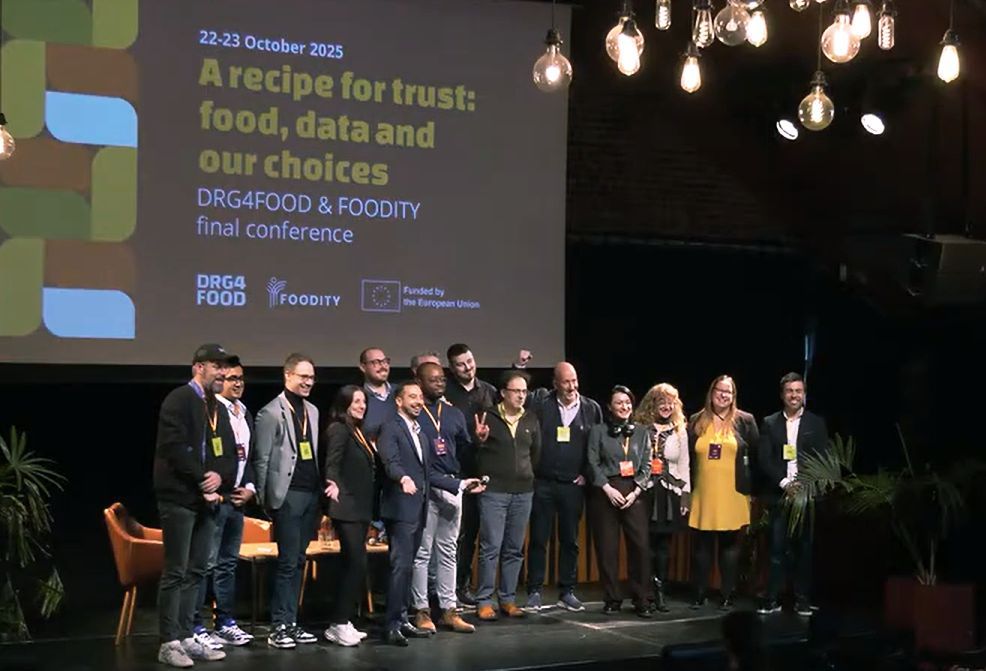
DRG4FOOD & FOODITY Final Conference took place on 22-23 October in Brussels, Belgium. Find the live recordings, presentations and more here!
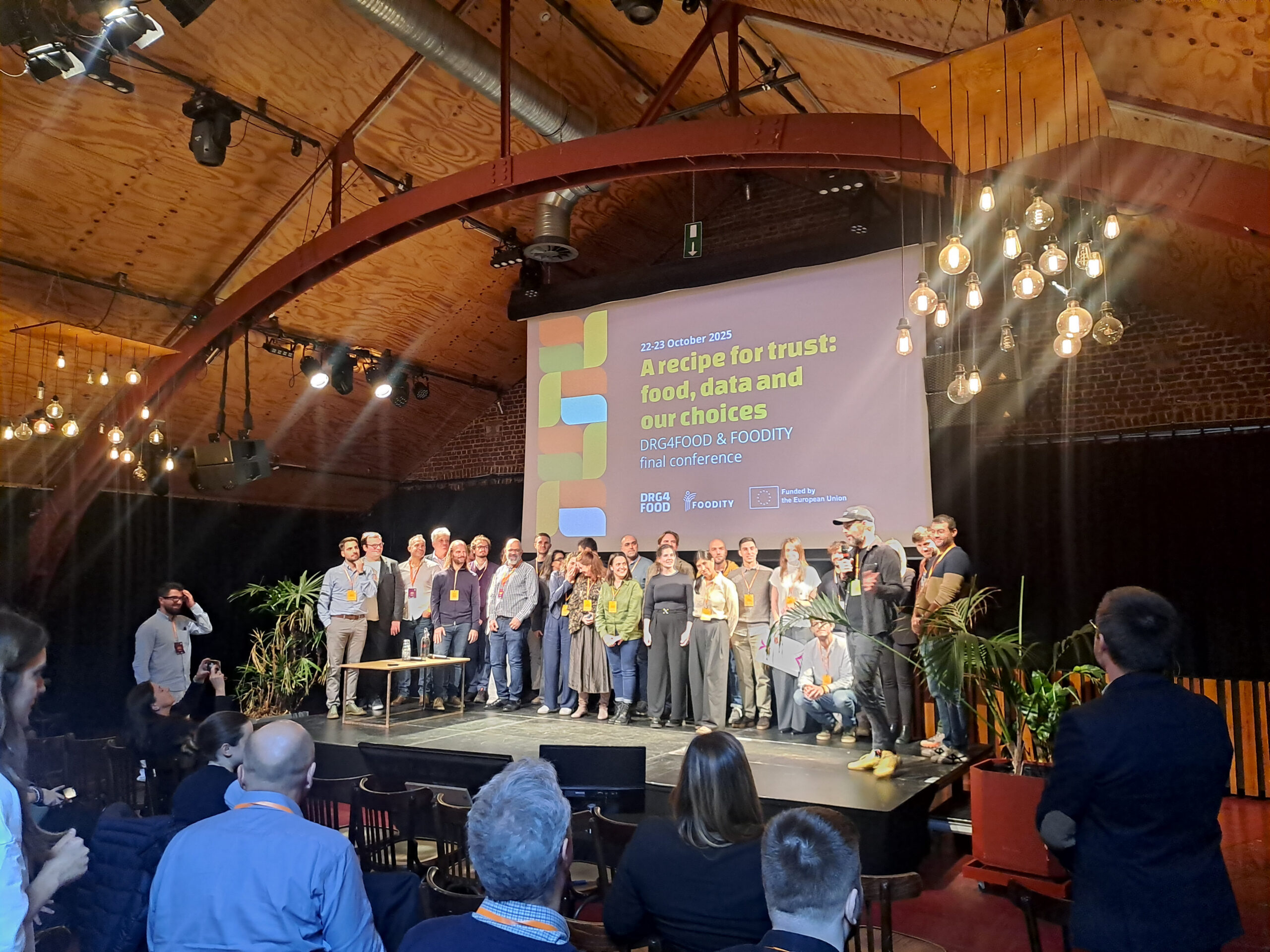
Both EU-funded projects hold together a conference with a common purpose: creating a dynamic ecosystem of digital solutions for food and nutrition that foster trustworthiness and put the citizen data right at the centre.
What to remember
▹1. Innovation without compromise
Data-driven food tech doesn’t mean sacrificing privacy. Projects showcased solutions that respect citizen data sovereignty, showing technological advancement and user privacy can coexist in the food sector.
▹ 2. Personalised nutrition and technology work hand-by-hand
From GENIE’s genetic nutrition approach to DISH’s individualized cooking experiences, and NutriSight’s instant nutritional information through smartphone snapshots, technology is making personalised nutrition accessible and actionable for consumers with diverse needs and preferences.
▹ 3. Social impact through smart food systems
The conference highlighted innovations addressing broader societal challenges: SafeNutriKids teaching children both healthy eating and digital literacy, and PINACLE’s system matching surplus food with the specific dietary needs of malnourished populations. These projects demonstrate how food innovation can simultaneously tackle food waste, malnutrition, and digital education.
Story of the conference
Breakout of Day 1
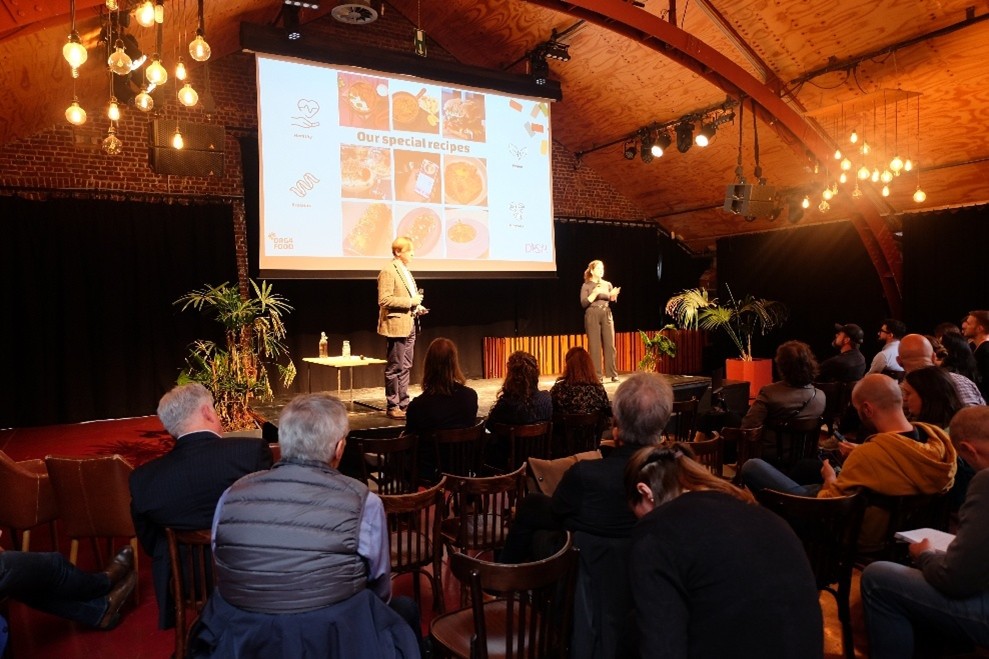
Session 1: Introduction of the open call winners and Tasting session: the DRG4FOOD & FOODITY open call purpose and methodology
Kai Hermsen (DRG4FOOD Coordinator) and Samuel Almeida (FOODITY Coordinator) opened the conference by welcoming participants and presenting the two-day agenda. Kai highlighted the importance of the intersection between food choices and digital applications related to food.
Samuel introduced the scope and procedures of the FOODITY open call, aimed at creating a dynamic ecosystem of digital solutions for food and nutrition that uphold citizens’ right to personal data sovereignty in Europe. The FOODITY project implemented a €2 million pilot development programme, funding 12 solutions that demonstrated the potential of data-driven innovation in food and nutrition while ensuring complete user control over personal data. The programme followed a three-phase structure, with only selected solutions progressing through all phases. Ultimately, three solutions reached the final stage, and one received a €7,500 prize, awarded during the final conference by an external jury.
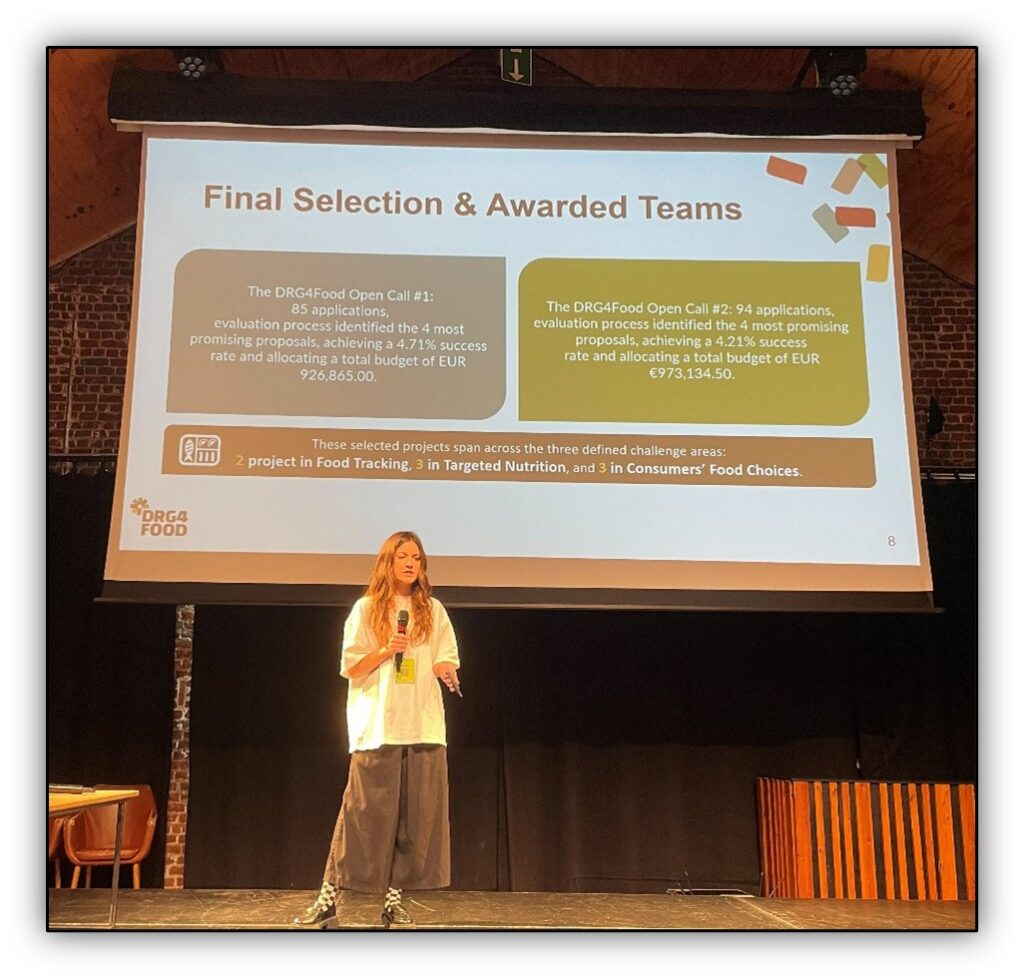
Milica Velimirovic from Inosens, the DRG4FOOD partner responsible for managing the cascade funding process, explained the rationale behind the selection of pilot solutions through two open calls totaling €1.9 million. DRG4FOOD selected eight pilot solutions across three use cases: food tracking, targeted nutrition, and consumer food choices.
Session 2: The FOODITY Open call pitches
During this session, the three projects arrived at the final stage of FOODITY selection project, pitched their solutions. The projects were:
- ONCONOURISH is reshaping how cancer patients manage their nutrition during treatment. By combining AI, scientific knowledge, and patient-centred design, the project delivers personalised dietary support that empowers patients, complements hospital care, and tackles the challenges of long-term adherence — Developed by Instituto IBIONS, Datipic, and TheMovemen.
- SEBP introduces a data-driven approach to employee benefits by linking companies, employees, and local producers. Its platform combines transparent sustainability metrics, digital management tools, and measurable impact data — enabling companies to promote responsible consumption while empowering employees to make eco-conscious choices — Developed by The Good Club and Agriventures.
- REDUCE focuses on cutting canteen plate waste through AI-powered insights and active user engagement. The platform helps catering companies make better decisions, reduce leftovers, and promote more sustainable dining habits by turning data into actionable, real-world solutions — Developed by Behavix, Spritz Matter, and the TESAF Department at the University of Padova.
FOODITY pointed a jury of 3 members, giving points to each project based on 4 main criteria:
- Innovation potential of the developed solution.
- Potential impact on citizens, including measures implemented to respect data rights.
- Economic, social, and environmental impact within the food value chain.
- Business sustainability measures.
The winner of the pitch competition gained an final prize of 7.500 Euros.
Session 3: The DRG4FOOD pitches
In session 3, the 8 solutions funded through the DRG4FOOD project pitches in 7 minutes each the most unique selling points of their solutions. The pilots has been divided in 3 main areas: food tracking, targeted nutrition and consumers’ food choices.
- ATTESTED (food tracking) develops a set of interoperable technologies to enhance efficiency in agriculture and food production. This “toolbox” will enable a transparent, efficient, and sustainable traceability and monitoring system covering the entire farm-to-fork journey, empowering both producers and consumers. – developed by Commons Lab, FiBL, and Valdibella.
- Cacao-Tech (food tracking) builds a circular, data-driven model using whole cacao pods. Through NIR-based quality checks and traceability, it links cacao quality to farmers and supports EU deforestation compliance. Tested in Ecuador, it reduces waste by 30% and turns by-products into high-value ingredients and fertilisers worth €302 million – developed by Pacha de Cacao, Wageningen University and The Czech Republic University.
- SafeNutriKids (Targeted nutrition) project brings together partners from Estonia, Bulgaria, and Turkey to create an AI-powered nutrition education app for children aged 6–12. Focusing on both healthy eating and digital literacy, it blends technology and interactive learning to promote better nutrition and responsible online behaviour – developed by Phase Growth, Trakia University business incubator go-up, Sabri Ulke food research foundation.
- NutriWell (Targeted nutrition) develops five AI-based enablers, focusing on improving nutrition and wellbeing for older adults (65+) before expanding to others. The project includes a Nutrition Data Space, Personal Data Wallet, AI Nutrition Planner, Cuisine Allocator, and Social Cooking tool, ensuring trusted, secure, and consent-based data sharing via i4Trust and dataU platforms. – developed by Innova Living, Institute of Technology and Development, Sofia development association.
- PINACLE (targeted nutrition) develops a smart tool that matches food donations with recipients’ dietary needs, promoting healthier and more sustainable diets. It digitizes food redistribution networks, supports responsible nutrition, reduces food waste, and ensures trusted data exchange, validated through real-life pilot cases. – developed by Konnecta system p.c., Cohesion network 2gether, Sapienza University of Rome.
- GENIE (targeted nutrition) transforms grocery shopping through ultra-personalized nutrition advice based on genetic, microbiota, and biochemical data. Developed by GUNDO, ADN Institut, and i3S, project integrates advanced biological insights into everyday food choices, helping users shop smarter and eat healthier. It will assess how such personalized diets improve gut microbiota and overall wellbeing. – developed by Gundo, ADNinstitut, I3S.
- DISH (targeted nutrition) individualises your cooking experience. By providing recipes that are tailored to your individual needs, it enables a healthier and more sustainable diet. DISH uses advanced graph technologies and methods from the domain of Artificial Intelligence to create individual cooking recipes, based on the concept of ingredient replacement and automated nutritional scoring. – developed by Synamic Technologies, Bulduri Tehnikums and the German Institute for Sports Nutrition.
- NutriSight (consumers’ food choices) aims to develop a tool that automatically extracts nutritional information from photos of food packaging. Using deep learning, it combines a machine learning model and API that work across multiple languages and countries. The tool will also present this data in a user-friendly way, such as through the Nutri-Score system. – developed by Open Food Facts and El Coco
Breakout of Day 2
Session 4: Appetite for more: towards a digitally responsible food system
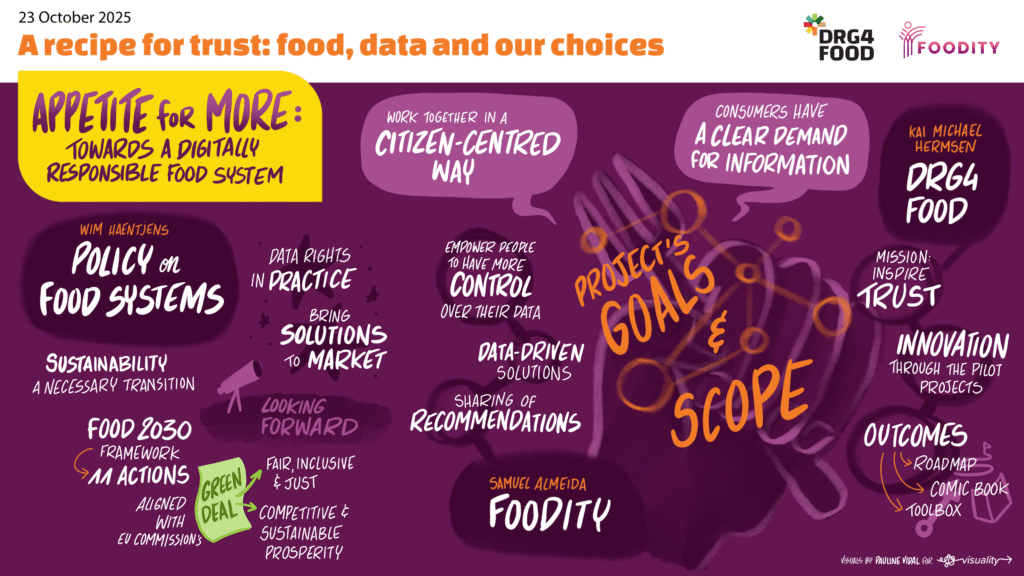
The second day’ s first session opened with Wim Haentjens from European Commission, his overview of the expected output from the original call for proposal HORIZON-CL6-2022-GOVERNANCE-01-10 and the next legislative priorities from FOOD2030 strategy. After the presentation a Q&A session was moderated and animated by the 2 projects coordinators, Samuel Almeida and Kai Hermsen, who followed with a presentation of the objectives of DRG4FOOD and FOODITY projects explaining the importance of relation between food choices and use of digital applications.
Session 5: The agony of choice: what’s for dinner
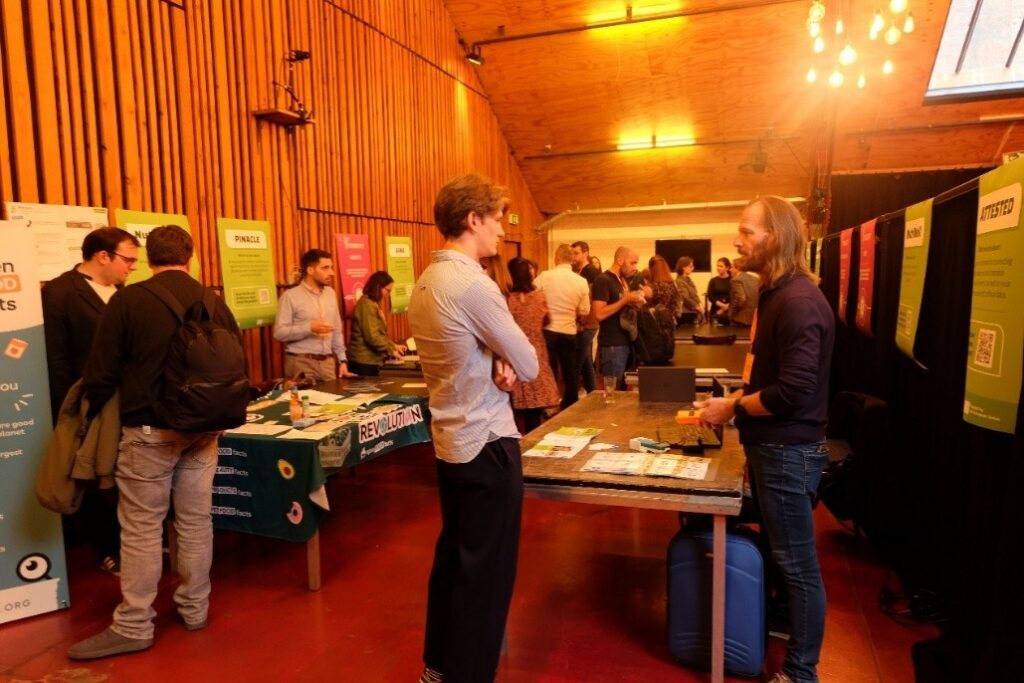
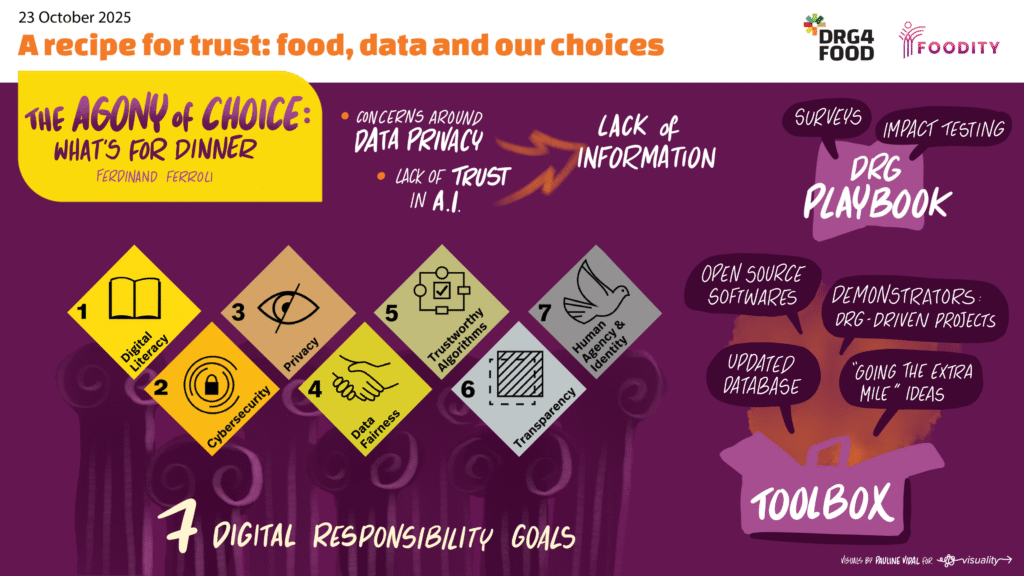
In this session, Ferdinard Ferroli from Identity Valley and Lorna Goulden from Twinds, both from the DRG4FOOD consortium, shared a slot to present the importance of the Digital Responsibility Goals, explaining what they are and why we need them, and furnish some best practice application of the DRGs meaning the DRG4FOOD toolbox with a demo on site.
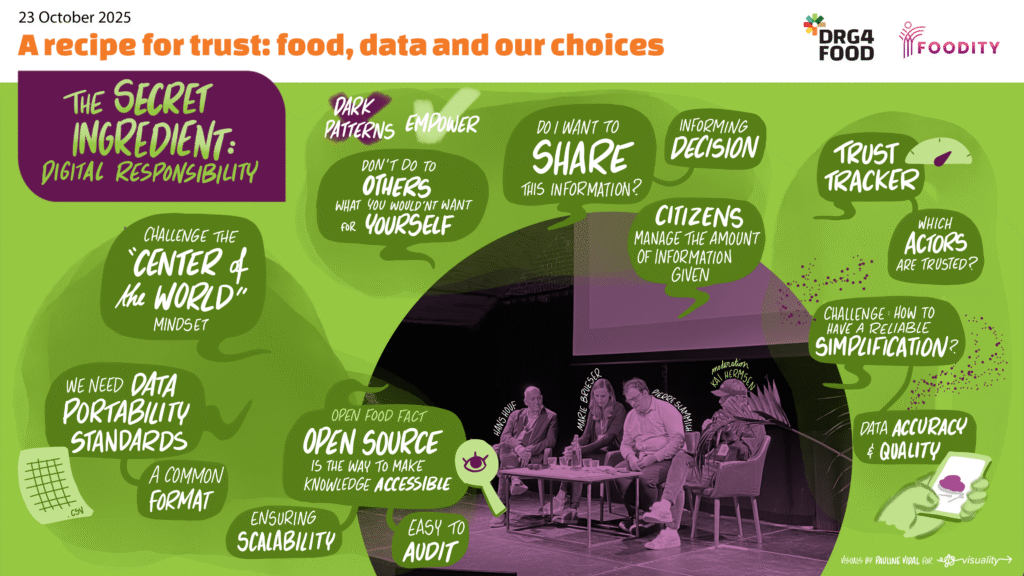
Session 6: The secret ingredient: digital responsibility
This panel discussion has been moderated by Kai Hermsen and foreseen 3 panelists:
- Hans Houf is a Jibe Company board member, leading DataU’s tech and business growth. He develops e-mobility and eldercare service models, while also holding multiple advisory and supervisory roles in European start-ups and scale-ups
- Marie Brueser is Senior Business Development Manager at EIT Food, the EU-funded food innovation community. With a PhD in plant genetics and experience in agrifood acceleration and corporate innovation, she’s passionate about leveraging technology for sustainable food systems.
- Pierre Slamich is Co-Founder of Open Food Fact, the “Wikipedia for Food”.
Scope of the panel was to have a conversation with experts external to the project providing their own prospective (from different point of view) on digital responsibility and the balance between transparency and IPR, privacy and data usability.
Session 7: Cooking it all up: insights into the DRG4FOOD scenarios
In this session, Filippo Sevi from Enea and Wiktor Capela from Premotec, presented the results of the DRG4FOOD map and gap analysis which set up the baseline for developing the DRG4FOOD roadmap and the policy brief. Moreover, Wiktor Capela presented the language tool used in the project.
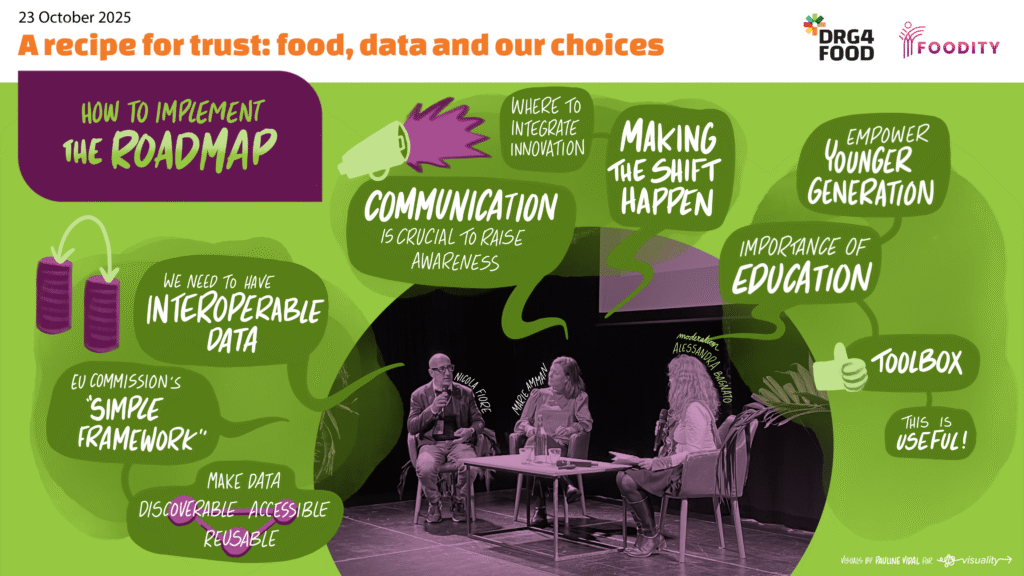
Session 8: How to implement the roadmap
In this panel discussion, Alessandra Bagnato from FOODITY moderated 2 panelists coming from 2 different side of the market:
- Nicola Fiore is a Software Architect at EGI Foundation. He has a strong background in cloud computing, data management, database systems, semantic technologies and artificial intelligence. Nicola is part of the Technical Solutions Team, bringing over a decade of expertise in designing and implementing scalable ubiquitous software solutions. He is the technical coordinator of the EOSC Beyond project.
- Marie Amman is a member of the investment team at Agrifood Tech Venture GmbH (formerly BayWa Venture GmbH), where she leads efforts in startup engagement and innovation. Her role focuses on strategic investments in emerging technologies aimed at making the food value chain more efficient and sustainable. Key investment areas include impact crops, alternative proteins, automation, and digitalization.
The idea of the panel is to ask to experts if they see any potential missing elements from our analysis and how they foreseen the future for the digitalization and the foody system.
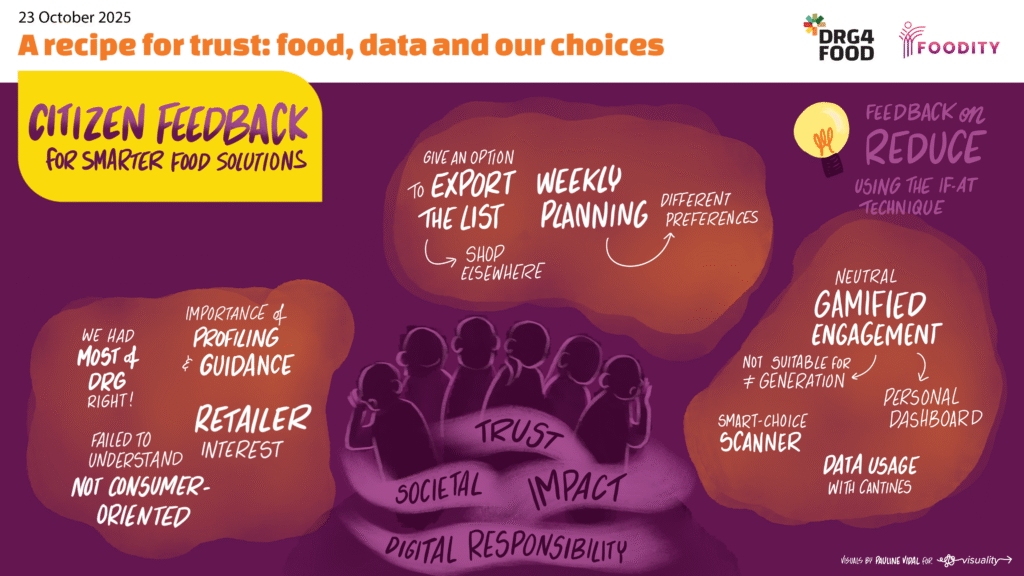
Session 9: Citizen feedback for Smarter Food Solutions
This interactive session, moderated and organized by FOODITY, involved one pilot solution funded through each project (GENIE and REDUCE) and will follow the IF-AT (Immediate Feedback Assessment Technique) methodology. The activity has been highly interactive, offering participants the opportunity to reflect on their solutions, receive feedback from the public, and engage with others on topics such as transparency, usability, sustainability, and citizen-centred design.
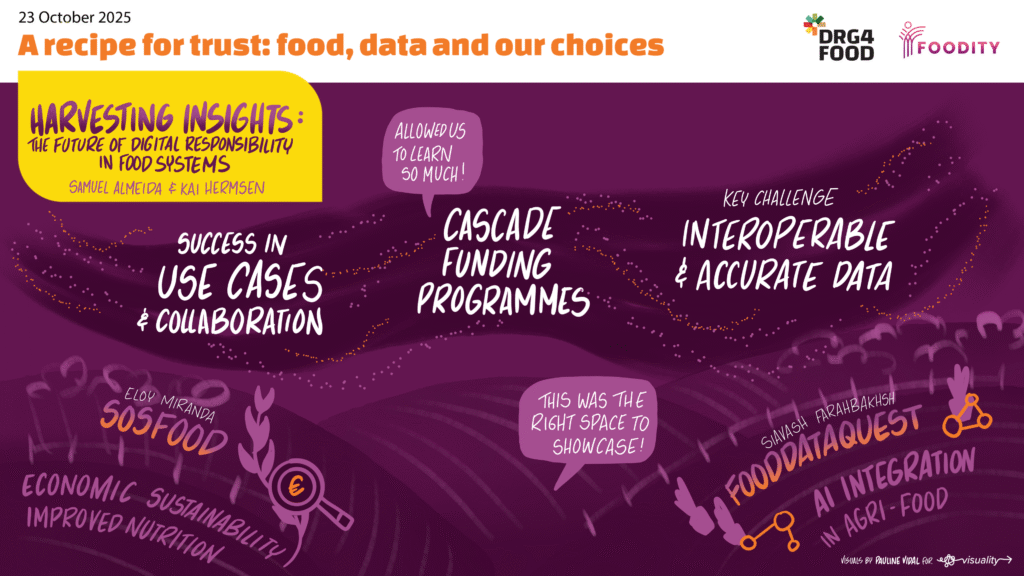
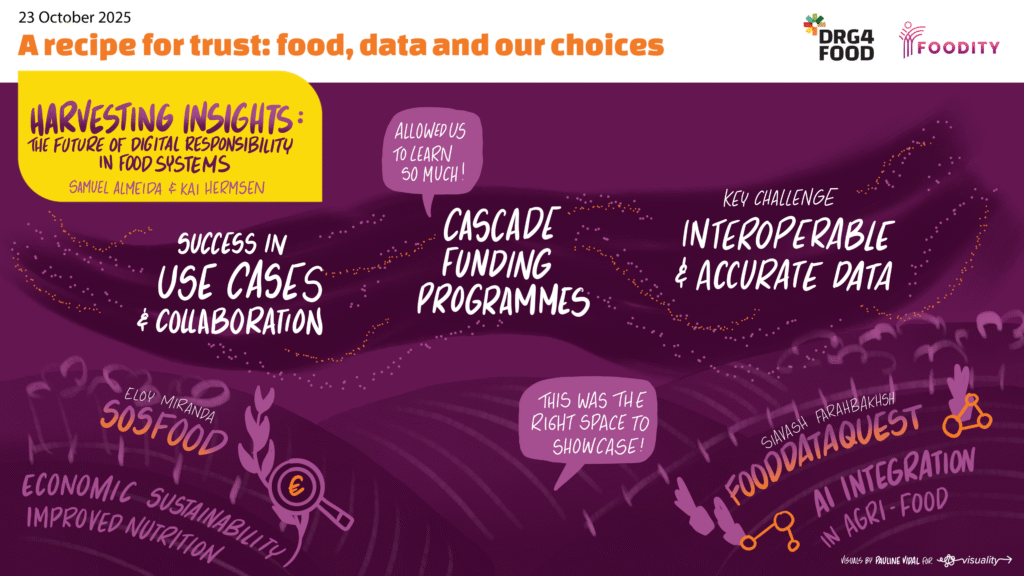
Session 10: Harvesting Insights: The Future of Digital Responsibility in Food Systems
In the last session, the coordinators of FOODITY and DRG4FOOD joined a self moderated conversation with the coordinators of SOS FOOD and FOOD Data Quest projects: Eloy Miranda and Siavash Farahbakhsh. In this last panel discussion the purpose was to wrap-up the key information of the day, summarize the outcomes of the conference and announce the continuation of the data4food cluster with the new recently started projects.
Thank you for joining us on this food & data journey!